
From AI-generated brand content to task automation and AI video, these are the tools making a real impact right now.
As is the landscape of AI, there is a lot of noise in the space, especially into 2026 where application of AI models are driving more intuitive user experience and more dedicated tools.
We spend a lot of time testing and evaluating these tools as part of the work we do at Design for Online®, both for our own workflows and for our clients. What follows are five tools that have caught our attention in early 2026. They are not all aimed at marketers specifically, but they all have clear applications for anyone running a business, managing content, or building a brand online.
Some of these are free. Some are still in beta. One of them is not even available in the UK yet. But all of them are worth understanding because they point to where things are heading and how they can benefit businesses directly but also marketing agencies and workflows to provide added value to your clients.
1. Google Pomelli
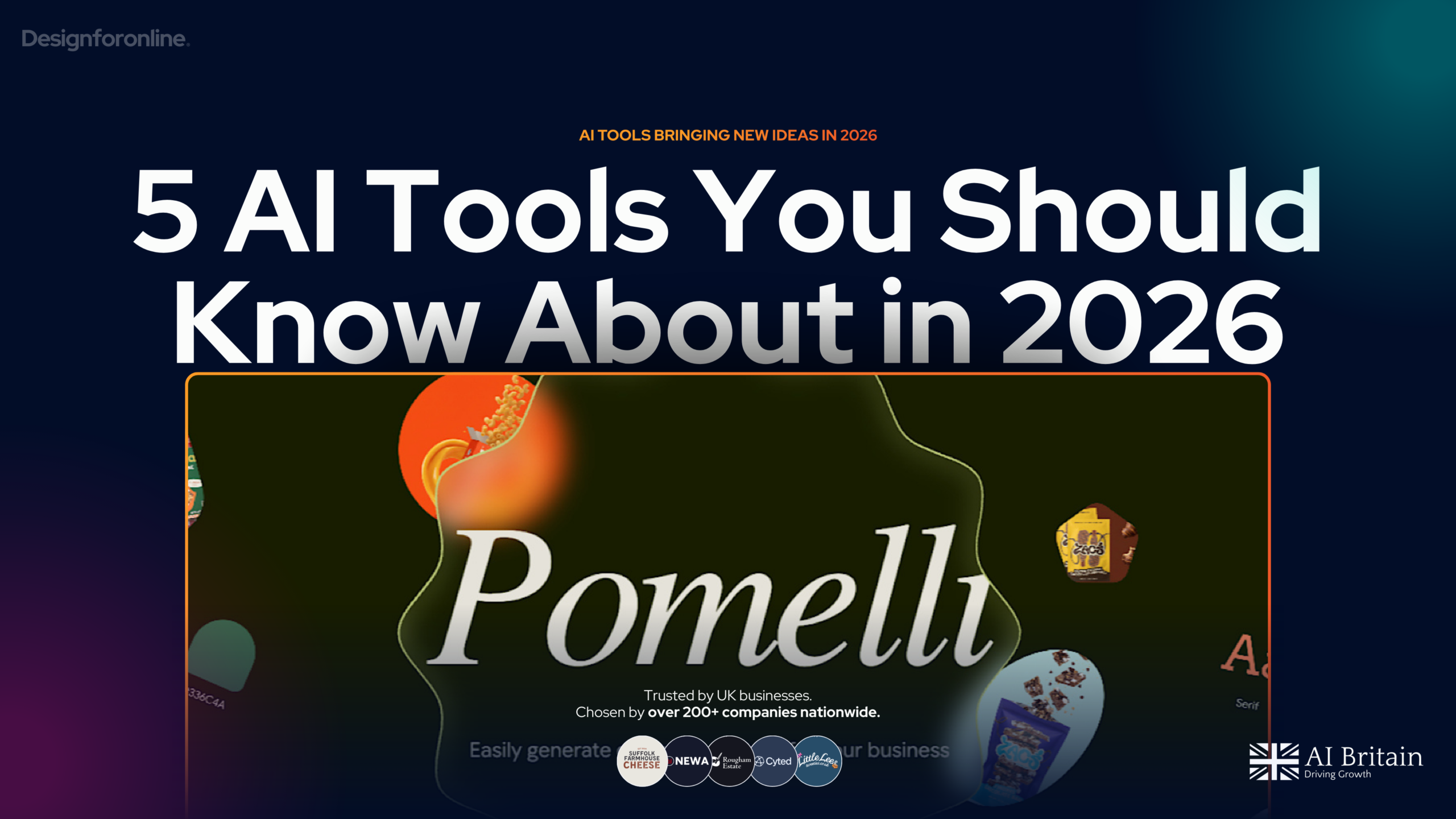
Pomelli is a new experiment from Google Labs and Google DeepMind. The concept is simple: you give it your website URL, it analyses your site to understand your brand identity (colours, fonts, tone of voice, imagery) and then generates social media posts, ad creatives and email banners that are consistent with your brand.
Google calls this your “Business DNA” profile. Once it has built that profile, you can ask it to generate campaign ideas or type in your own brief. It will produce multiple variations of content that you can edit and download. In January 2026, they also added Pomelli Animate, powered by Google’s Veo 3.1 video model, which turns your static content into short video animations suited to Reels, TikTok and YouTube Shorts.
Availability: Pomelli is currently a free public beta in the US, Canada, Australia and New Zealand. It is not available in the UK yet, but given that it sits within Google Labs, we expect it to roll out more widely over time.
Our take: For SMBs who struggle with producing consistent branded content, this is a solid starting point. It handles the volume work well. Where it falls short is in strategic thinking. It doesn’t understand your audience, your competitors, or the nuances of different platforms. It won’t replace a thought-out social strategy, but it could save a lot of time on the production side. One to watch for when it lands in the UK.
2. Seedance 2.0
ByteDance (the company behind TikTok) released Seedance 2.0 in February 2026 and it went viral almost immediately. The quality of the video output is a significant step up from anything we have seen in the AI video space. We are talking 2K resolution, native audio with lip-synced dialogue, and the ability to reference existing video clips for camera movements, choreography and lighting.
It supports multi-modal input, so you can combine text prompts with uploaded images, video clips and audio to guide the output. The results are cinematic in places. It has already drawn comparisons to OpenAI’s Sora and Google’s Veo, and in many areas it appears to be ahead.
Worth noting though, Seedance 2.0 has already raised questions around copyright and intellectual property. Within a day of launching, users had been generating videos featuring the likenesses of real actors and recreating scenes from existing films. Industry bodies including the Motion Picture Association and SAG-AFTRA raised concerns about the lack of safeguards. It is something to be aware of if you plan to use it commercially.
Availability: Currently in limited beta, with a full public launch expected late February or early March 2026. Pricing has not been confirmed but is expected to be subscription-based.
Our take: The potential here for marketers is clear. Quick concept videos, product demos, social content and short-form ads could all be produced at a fraction of the time and cost. If you are going to use it for commercial work, stick to original content and be mindful of what you are generating. The technology is impressive and the copyright questions around AI video are ones the whole industry will need to work through over the coming months.
3. Claude Cowork
If you have used ChatGPT or Claude before, you will be familiar with the typical back-and-forth. You ask a question, you get an answer, you refine it, you copy it somewhere useful. Cowork from Anthropic changes that dynamic. Instead of answering questions, it carries out tasks.
Cowork launched in January 2026 as part of the Claude desktop app. You give it access to a folder on your computer and then describe what you want done. It can read files, create documents, organise folders, build spreadsheets from receipt photos, draft reports from source material, and work through multi-step processes without needing you to guide each step. It is built on the same technology as Claude Code (Anthropic’s developer tool) but packaged for non-technical users.
It now runs on both macOS and Windows (the Windows version launched on 11 February 2026 with full feature parity). There is also a growing plugin system that connects it to external tools for sales, finance, marketing and productivity workflows.
To give you an idea of how much attention this has received, Microsoft has reportedly begun encouraging internal teams to adopt Claude tools, and the broader market response suggested that investors see this kind of AI agent as a genuine shift in how knowledge work gets done.
Availability: Available now on the Claude desktop app for Pro (£16/month), Max, Team and Enterprise subscribers.
Our take: This is the tool on this list that best represents where AI is heading. We have been using it for document preparation, research synthesis and file management. For agencies and small businesses who deal with a lot of repetitive knowledge work, it is worth trying. It is still a research preview and it can occasionally get things wrong, so always review what it produces. But the shift from “AI as a chat tool” to “AI as a colleague” is a meaningful one.
4. Google Stitch
Stitch is a free AI design tool from Google Labs that takes a plain English description of a web or mobile app and generates complete UI designs with production-ready HTML and CSS code. You can also upload a hand-drawn sketch, a screenshot or a wireframe and it will produce a polished digital version.
Google acquired the original tool (Galileo AI) and relaunched it as Stitch at Google I/O in May 2025. It is powered by Google’s Gemini 3 Pro model and includes one-click export to Figma, which means you can generate a concept in Stitch and then move straight into your design workflow for refinement.
In practice, it is best used for the early stages of a project. Getting past the blank canvas, testing layout ideas, putting something in front of a client quickly. The output is clean but tends towards generic layouts, so it still needs professional refinement before it is ready for production.
Availability: Free via Google Labs at stitch.withgoogle.com. You get up to 350 generations per month on the standard mode and 50 on the experimental (higher quality) mode.
Our take: As a web design agency, this is a tool we are watching closely. It is useful for rapid prototyping and for showing clients early concepts without investing significant design time up front. It does not replace a designer or developer, and it shouldn’t. The layouts need work, the styling is often basic, and it cannot handle complex multi-screen flows well. But for getting an idea out of your head and into something visual quickly, it is hard to beat. We see it as a useful addition to the early stages of our design process and quick mockups for client feedback.
5. Google NotebookLM
NotebookLM has been around for a while now, but the updates that have landed over the last few months have turned it into something genuinely useful for day-to-day work. At its core, it is a tool where you upload your own documents (PDFs, Google Docs, links, notes) and then interact with an AI that is grounded specifically in those sources. It does not make things up from its general knowledge. It works from what you give it.
Recent additions include Deep Research, which can autonomously search the web and compile citation-backed reports. There are Data Tables, which let you extract structured information from uploaded documents and export to Google Sheets. Audio Overviews generate AI podcast-style discussions of your content, and it can now produce slide decks and video overviews from your notes. The chat function has also been significantly upgraded with a 1 million token context window, so it can handle large document collections.
Google is also testing a Personal Intelligence feature, which would allow NotebookLM to learn your preferences and working style over time, adjusting its tone and level of detail to match how you work.
Availability: Free to use at notebooklm.google.com. Additional features are available through Google AI Pro plans and Workspace subscriptions.
Our take: We use NotebookLM for client research, competitor analysis and pulling together strategy documents. If you are working on a pitch, preparing a PPC strategy, or reviewing a batch of competitor websites, being able to upload everything and then ask questions against that specific set of information is a real time saver. The Audio Overview feature is also surprisingly good for getting a different perspective on your own content. It is one of those tools that rewards the time you put into setting it up properly.
What ties these together
These five tools cover different areas: brand content, video production, task automation, design and development, research and strategy. But the common thread is that none of them are trying to replace expertise. They are trying to speed up the parts of the work that take the most time while leaving the thinking, the strategy and the creative direction to you.
The landscape is moving quickly and it will continue to do so throughout 2026. Not every new tool will be worth adopting, and that is fine. What matters is understanding which ones can genuinely improve how you work and where they fit within what you are already doing.
If you want to explore how any of these tools could work for your business, or if you want help navigating the AI landscape more broadly, we are always happy to have that conversation.
About Design for Online®: We are a full service digital marketing and design agency based in Bury St Edmunds, Suffolk. Our services include web design, SEO, PPC, AI business automation, photography and videography. We work with businesses across the UK to help them grow online.
For enquiries: hello@designforonline.com