

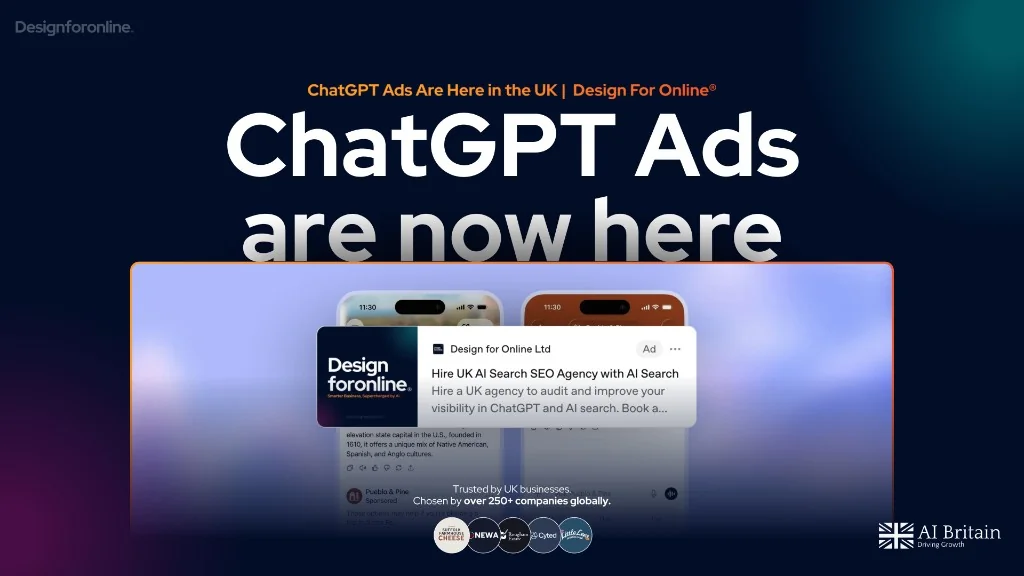
ChatGPT Ads are now available to UK advertisers, introducing a new way for businesses to reach people while they are researching, comparing options and making decisions.
Design for Online was given original access to the beta OpenAI Ads Manager, and we have now set up and launched our first UK campaigns. The platform is still developing, but our initial experience has given us a useful look at how ChatGPT advertising works, where it differs from Google Ads, and what businesses should consider before investing.
This is not at all to say that ChatGPT Ads will replace established advertising platforms. Google remains the dominant search platform by a significant margin. However, ChatGPT represents a new type of advertising opportunity, built around conversations and context rather than a conventional list of search keywords.
Are ChatGPT Ads available in the UK?
Yes. UK businesses can now create campaigns through OpenAI’s self-service Ads Manager, although the platform remains in beta and access may continue to develop.
Ads may be shown to adult users on the Free and ChatGPT Go plans. Users subscribed to Plus, Pro, Business, Enterprise and Education plans will not see advertising.
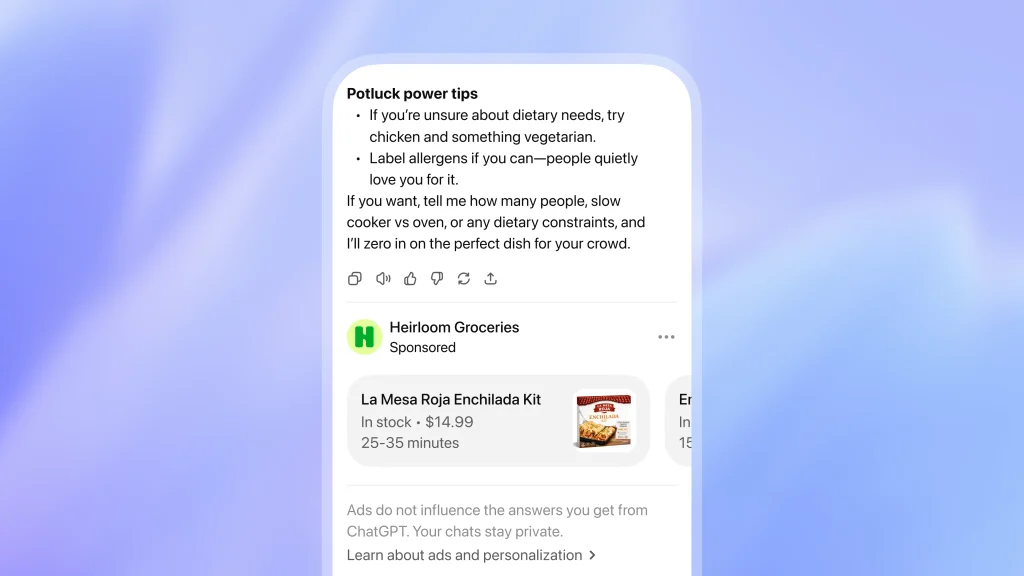
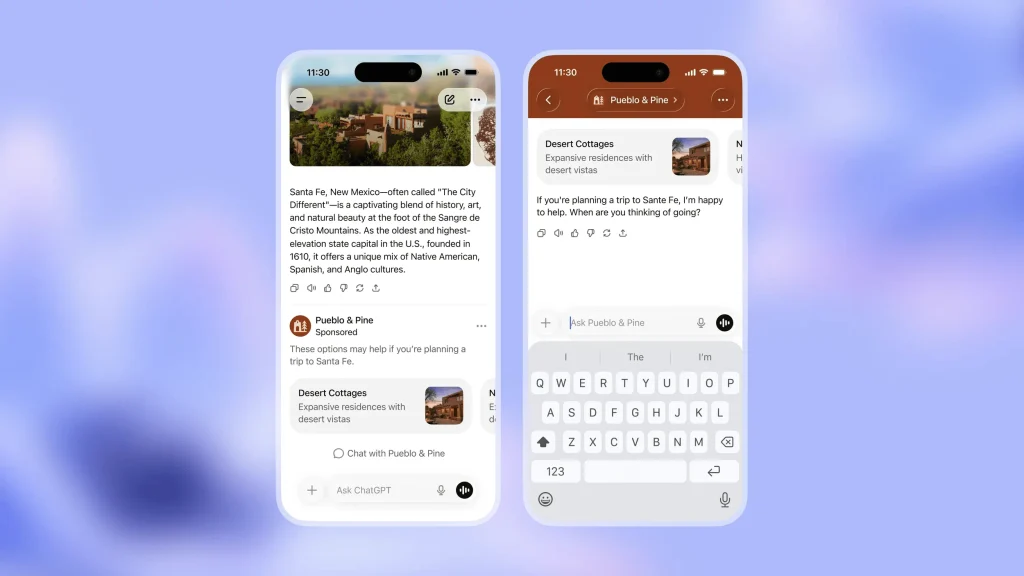
The adverts are clearly labelled and displayed separately from ChatGPT’s response. Paying to advertise does not influence the answer ChatGPT provides, and advertisers are not given access to users’ private conversations.
This distinction is important. ChatGPT Ads provide paid exposure alongside relevant conversations. They are not the same as being organically mentioned, cited or recommended within an AI-generated answer.
How large is the ChatGPT audience in the UK?
OpenAI has not published a current figure showing exactly how many UK users are eligible to see ads. The available research does, however, demonstrate the scale of ChatGPT’s UK audience.
Research from Ipsos iris found that 9.5 million people in the UK used OpenAI’s website or app during February 2025, representing approximately one in five UK internet users at the time.
Usage continued to grow rapidly. Ofcom recorded 1.8 billion UK visits to ChatGPT during the first eight months of 2025, compared with 368 million during the same period in 2024.
More recent Ofcom research found that 54% of UK adults now use AI tools, including services such as ChatGPT, Gemini and Copilot.
These figures should not be treated as an advertising reach forecast. Only a proportion of ChatGPT’s audience is on an ad-supported plan, and OpenAI has not published the precise UK split between Free, Go and paid subscriptions.
Nevertheless, the available data indicates that ChatGPT Ads could provide access to a substantial multi-million-user audience in the UK.
How do ChatGPT Ads work?
ChatGPT advertising is based primarily on the context of a conversation.
With traditional search advertising, a business might bid on keywords such as “SEO agency UK”, “accounting software” or “best business laptop”. ChatGPT Ads instead allows advertisers to describe the types of conversations in which their product or service could be relevant.
These descriptions are called context hints.
For example, a digital marketing agency might provide context hints such as:
- A business owner is looking for an agency to improve their Google and AI search visibility.
- A marketing manager is comparing SEO, AEO and GEO services.
- A UK company wants pricing for ongoing SEO support.
- A business is looking to outsource its digital marketing.
- A company wants professional help appearing in ChatGPT and Google AI Overviews.
OpenAI uses these hints to help determine whether an advert is relevant to the conversation. They guide matching, but they do not operate as exact-match keywords.
An ad group can then contain:
- A destination URL
- A short advert title
- A description
- A square image
- A maximum bid
- Context hints
- Location targeting
- Audience settings where available
OpenAI has also introduced an Advertiser API, customer audiences, product feeds, conversion-focused campaigns and geographical targeting. This suggests that Ads Manager is intended to develop into a much broader advertising platform over time.
Our initial experience with ChatGPT Ads
Setting up a campaign was relatively straightforward.
Compared with Google Ads, there are currently far fewer settings, campaign types and targeting options to work through. A business can create its campaign, specify a budget, add context hints, upload an advert and begin the review process relatively quickly.
Our first UK test campaign began generating impressions almost immediately. Within its initial period of activity, it had produced several thousand impressions and dozens of website visits.
The cost per click was also below what we would typically expect to pay for comparable digital marketing and agency-related searches on Google.
That is encouraging, but it should not be treated as an established ChatGPT Ads benchmark. Costs will vary by industry, competition, targeting, advert quality and the conversations in which an advertiser wants to appear.
What became clear very quickly is that context hints require careful thought.
A broad hint about SEO or appearing in ChatGPT could reach someone who simply wants instructions they can follow themselves. That person may be interested in the subject, but they are not necessarily looking to hire an agency.
A stronger campaign needs to distinguish between someone asking:
How can I improve my website’s SEO?
and someone asking:
Can you help me find a UK agency that provides SEO, AEO and GEO services?
Both conversations concern SEO, but only one clearly indicates commercial intent.
This makes context-hint planning one of the most important parts of building a ChatGPT Ads campaign.
The traffic is real, but the intent is often earlier in the journey
Early results from our campaign, and from other UK advertisers testing the same channel, suggest the clicks themselves are genuine. People are arriving from labelled ads, not from empty traffic.
The more useful question is where those people sit in the buying journey. A Google search such as “SEO agency UK” usually means someone is already looking for a supplier. A ChatGPT conversation can start much earlier: someone exploring a problem, comparing ideas, or simply clicking through because the topic has come up.
That often looks more like the top or middle of the funnel than a ready-to-enquire click. Direct-response landing pages built for high-intent search can therefore underperform, even when the cost per click looks attractive.
ChatGPT Ads currently looks a better fit for brand education, explanation and demand-building than for treating it as another slot in the same Google Ads budget. If you do test it for leads, the destination page needs to match that earlier stage: a clear explanation of the offer, trust, and a lighter next step, rather than a hard “enquire now” page aimed at someone who already knows who they want to hire.
The potential advantages of ChatGPT Ads
Reaching people while they are actively researching
People often use ChatGPT to explore a problem in more detail than they would through a short Google search.
They may explain their circumstances, budget, priorities and concerns before asking for possible solutions. That creates the potential for an advertiser to appear at a meaningful point in the decision-making process.
A less crowded advertising market
ChatGPT Ads are considerably newer than Google Ads, Meta Ads or Microsoft Advertising. Many businesses have not yet created an account, developed a strategy or allocated a budget to the platform.
Fewer advertisers could mean less competition within some sectors and potentially lower advertising costs during the platform’s early development.
This is not guaranteed. Competition and prices are likely to increase if adoption grows, but early advertisers have an opportunity to learn before the platform becomes more established.
Context beyond individual keywords
A Google search normally provides a short query. A ChatGPT conversation can contain considerably more context about what someone is trying to achieve.
Advertisers cannot view those private conversations, but OpenAI can use the context to determine whether an advert may be relevant. If the matching improves, this could allow businesses to reach people based on a more complete understanding of their requirements.
Early experience can become an advantage
New advertising platforms take time to understand.
Businesses testing ChatGPT Ads now can begin learning which context hints, offers, advert formats and landing pages produce the strongest engagement. That knowledge may become increasingly valuable as more advertisers enter the market.
Paid and organic AI visibility can work together
ChatGPT Ads provide immediate paid visibility, while SEO, AEO and GEO work towards longer-term organic visibility across traditional and AI-powered search.
A business does not necessarily need to choose between them. Paid advertising can test messaging and demand while an organic strategy develops the content, authority and technical signals required for sustainable search visibility.
The current limitations
ChatGPT Ads also has some important limitations.
The platform is still in beta
Features, reporting, bidding options and campaign controls are likely to change. Advertisers should expect the product to evolve and avoid treating its current format as final.
Less granular control than Google Ads
Google Ads has been refined over more than two decades. It provides extensive keyword controls, negative keywords, audience segments, automated bidding, placement data, attribution tools and established integrations.
ChatGPT Ads already includes context hints, location targeting, custom audiences and conversion measurement, but it does not yet provide the same depth of control or historical data.
Advertisers are also unlikely to receive an equivalent of a traditional search-term report containing what an individual typed or discussed. This protects user privacy, but it can make it harder to understand precisely why an advert was matched to a particular conversation.
Limited performance benchmarks
There is not yet enough independent data to establish dependable benchmarks for click-through rates, cost per click or conversion rates across different UK sectors.
Early results should therefore be treated as individual campaign observations rather than industry standards.
A narrower addressable audience
ChatGPT Ads only appear on eligible ad-supported experiences. Paid subscribers will not see them, reducing the addressable audience compared with ChatGPT’s total number of users.
Measurement is still developing
OpenAI provides a measurement pixel and Conversions API for recording website activity attributed to ChatGPT Ads. However, advertisers should also use carefully structured UTM parameters, Google Analytics and their own lead or sales reporting.
As with any new advertising platform, analytics services and attribution tools will need time to develop more complete integrations.
ChatGPT Ads compared with Google Ads
ChatGPT Ads should not currently be viewed as a replacement for Google Ads.
Ofcom reports that Google Search is used by 82% of UK adults and processes approximately three billion UK searches each month. Google remains the established and dominant platform for capturing existing search demand.
The two platforms currently offer different opportunities:
| Area | ChatGPT Ads | Google Ads |
|---|---|---|
| Primary intent signal | Conversation context | Search queries and keywords |
| Platform maturity | New and in beta | Established over decades |
| Targeting control | Context hints, locations and selected audiences | Extensive keywords, audiences, exclusions and automated bidding |
| Reporting | Developing measurement and attribution tools | Mature reporting and third-party integrations |
| Competition | Potentially lower in newer categories | Highly competitive in established markets |
| Best current use | Testing conversational discovery and earlier-stage research | Capturing established search demand at scale |
For most businesses, ChatGPT Ads currently makes the most sense as an additional test channel alongside Google Ads, rather than a substitute for it.
Which businesses should consider testing ChatGPT Ads?
ChatGPT Ads could be particularly relevant for businesses selling products or services that customers research carefully before making a decision.
This could include:
- Professional services
- Software and technology
- Travel and hospitality
- Education and training
- Home improvement
- Financially significant purchases
- Business-to-business services
- Specialist ecommerce products
- Marketing and creative services
A business is more likely to benefit if it has:
- A clear product or service
- A well-defined customer problem
- A strong landing page
- Reliable website analytics
- Sufficient margin to test a new channel
- A process for following up enquiries
- A willingness to refine campaigns as the platform develops
Businesses should avoid launching broad campaigns simply because the platform is new. The offer, context hints and destination page still need to match what the potential customer is trying to achieve.
How do SEO, AEO and GEO fit into this?
ChatGPT advertising and AI search optimisation are connected, but they are not the same service.
ChatGPT Ads allow a business to pay for a clearly labelled placement. SEO, Answer Engine Optimisation and Generative Engine Optimisation aim to improve how a business is understood, ranked, mentioned and cited organically.
A complete search strategy can include:
- Traditional SEO for Google and other search engines
- AEO for direct answers and conversational searches
- GEO for visibility within generative AI platforms
- ChatGPT Ads for paid exposure beside relevant conversations
- Google Ads for established commercial search demand
Our AI Search Optimisation services focus on improving authority, content structure, factual signals, schema and visibility across ChatGPT, Google AI Overviews, Gemini and Perplexity.
Our SEO packages also combine traditional SEO with AI visibility optimisation, helping businesses prepare for both established search engines and the growing use of AI assistants.
Can Design for Online manage ChatGPT Ads campaigns?
Yes. Design for Online can help UK businesses set up, run and monitor campaigns through ChatGPT Ads Manager.
Our support can include:
- Assessing whether ChatGPT Ads suits your business
- Campaign and budget planning
- Context-hint research and development
- Advert copy and creative
- Landing-page selection and optimisation
- Measurement Pixel and analytics setup
- UTM and conversion tracking
- Campaign monitoring and refinement
- Reporting and performance analysis
- Integration with Google Ads, SEO, AEO and GEO strategies
Because the platform is new, we will approach campaigns as controlled, measurable tests. We will not assume that a strategy taken directly from Google Ads will work in the same way within a conversational platform.
Our initial verdict
ChatGPT Ads is one of the most interesting new advertising channels to emerge in recent years.
It offers access to a large and rapidly growing audience, with the potential to reach people while they are actively exploring choices and working towards a decision. Initial costs may also be attractive in sectors where advertiser competition is still relatively low.
At the same time, the platform remains in beta. Targeting and reporting are less granular than Google Ads, independent performance benchmarks remain limited, and advertisers will need to spend time refining how they describe relevant conversations. Early traffic also appears to sit further up the funnel than typical search clicks, so the landing page and the job you give the campaign need to reflect that.
We do not expect ChatGPT Ads to replace Google Ads. Google remains the dominant search advertising platform and will continue to form an important part of most paid-search strategies.
However, new platforms create new opportunities. Businesses that begin testing now can build experience, gather their own data and understand the channel before it becomes significantly more competitive.
If you would like to discuss whether ChatGPT Ads could work for your business, contact Design for Online or explore our paid advertising services.
This article reflects the capabilities available and our initial experience as of 24 August 2026. ChatGPT Ads remains a developing platform, and features or availability may change.
ChatGPT Ads FAQs
Who can see ChatGPT Ads?
Ads may appear to eligible adult users on the Free and ChatGPT Go plans. Plus, Pro, Business, Enterprise and Education subscriptions remain ad-free.
Do ChatGPT Ads influence the answers people receive?
No. Advertisements are labelled and displayed separately from ChatGPT’s answer. Paying for an advert does not make a business more likely to be organically recommended.
Can UK businesses advertise on ChatGPT?
Yes. Eligible UK businesses can create campaigns through OpenAI’s self-serve Ads Manager, although the platform is still in beta and access, features and approval processes may continue to change.
What is OpenAI Ads Manager?
OpenAI Ads Manager is the official console for creating, launching and reporting on ChatGPT Ads. UK advertisers can sign up at ads.openai.com, then build campaigns with context hints, creative, bidding and measurement tools.
How much do ChatGPT Ads cost?
Costs depend on the selected bidding method, competition and campaign targeting. There is not yet a dependable standard UK cost per click across different sectors, so businesses should begin with a controlled test budget.
Are ChatGPT Ads better than Google Ads?
They serve different purposes. Google Ads captures established search demand using mature keyword and audience systems. ChatGPT Ads reaches people within relevant conversations and may provide an additional opportunity during research and comparison.
Can ChatGPT Ads be tracked?
Yes. OpenAI provides a Measurement Pixel and Conversions API. Advertisers should also use UTM tracking, website analytics and internal lead or sales data.
Can Design for Online set up a ChatGPT Ads campaign?
Yes. We can help with strategy, account setup, context hints, creative, tracking, landing pages, campaign management and integration with wider SEO, AEO, GEO and paid advertising activity.
About Design for Online®: We are a full service digital marketing agency in Bury St Edmunds, Suffolk. Our services include web design, SEO, PPC, AI business automation, photography and videography, and we work with businesses across the UK to help them grow online. For enquiries: hello@designforonline.com


