
On 9 June 2026, Anthropic launched Claude Fable 5, and it is the most capable model the company has ever made generally available. It also arrived alongside a more restricted sibling called Claude Mythos 5, and landed on Amazon Bedrock and the Claude Platform on AWS the same day.
If you have seen the headlines and you are trying to work out what any of it means for your business, your workflows, or your budget, this is the plain English breakdown. We have read through the launch detail so you do not have to.
At Design for Online® we build AI into real business systems every week, so we are less interested in the benchmark bragging rights and more interested in the practical question: should you care, and if so, where does it fit?
What is Claude Fable 5 in simple terms
Anthropic now has four tiers of model: Haiku, Sonnet, Opus, and a new top tier called Mythos. Fable 5 is a Mythos-class model that has been made safe enough for everyone to use.
In short, it is the powerful version of the most powerful thing they have built, with guardrails added so it can be released to the public.
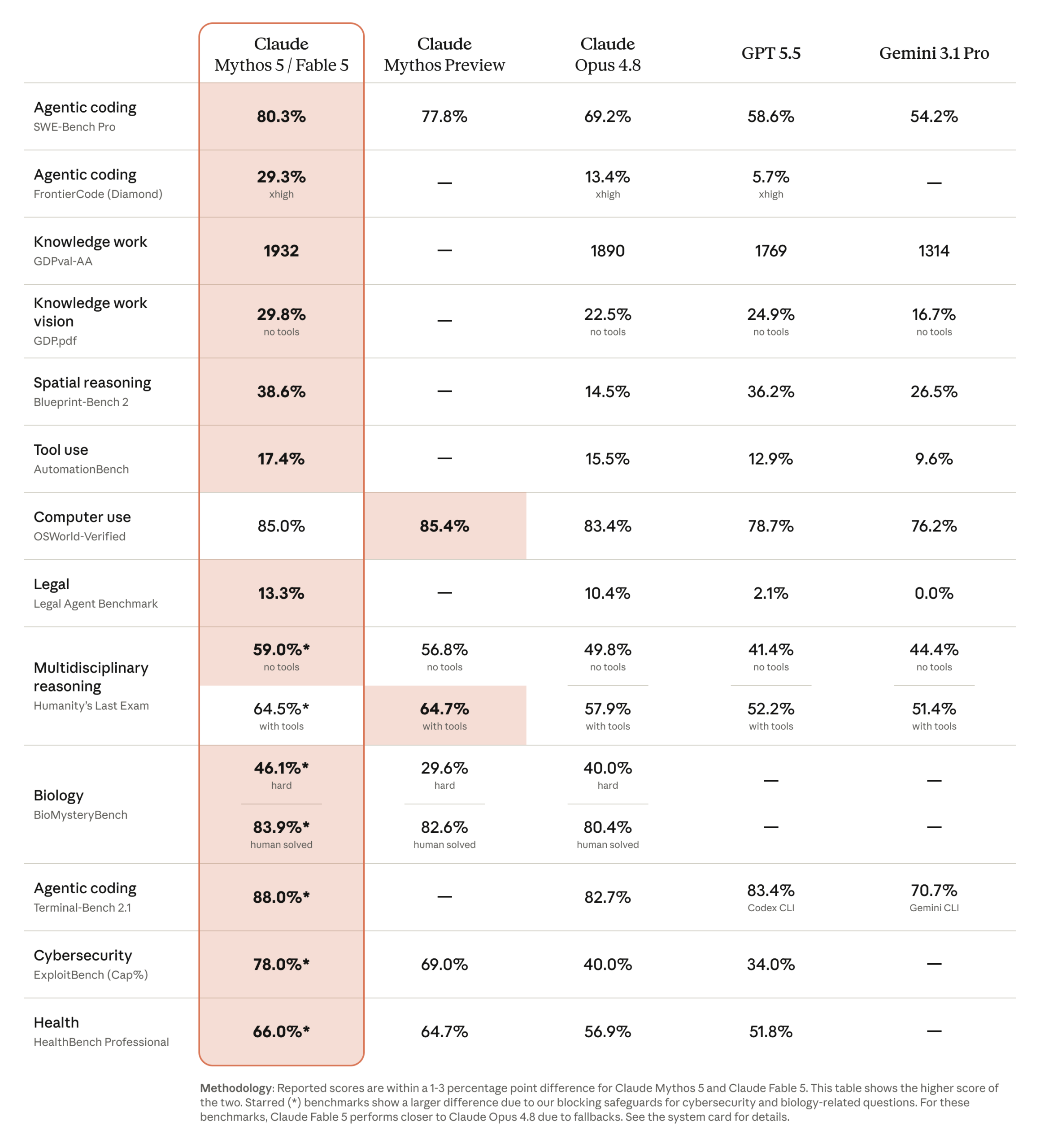
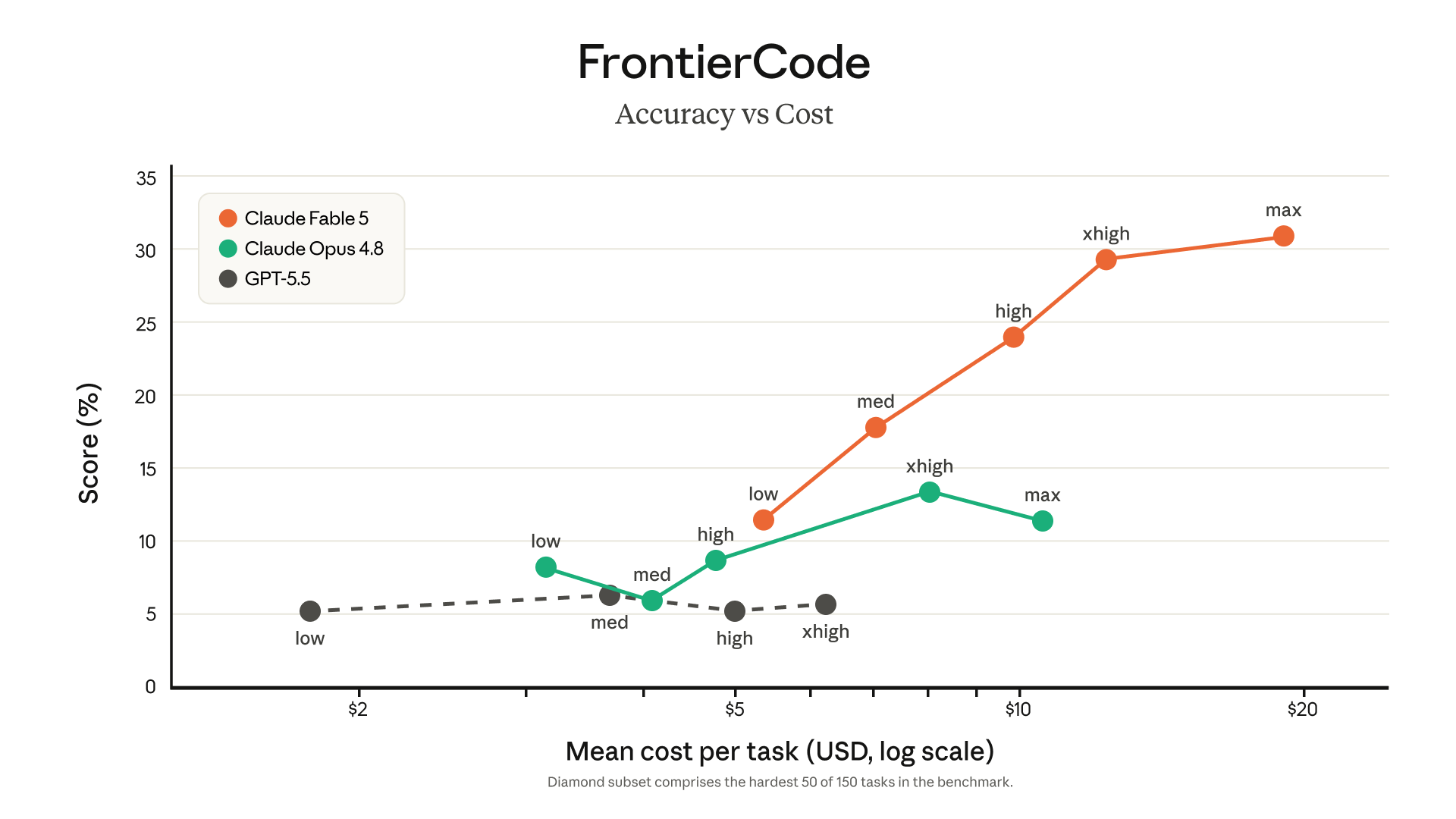
The one line that matters most for businesses is this: Fable 5 is built for long, complex, run-it-and-leave-it work. The longer and more involved the task, the bigger its lead over previous models. Anthropic and AWS both describe it as a model that can work for days at a time inside an agent setup like Claude Code, planning its own approach, checking its progress, and refining its work as it goes.
That is a genuine shift. Most AI work today is a back and forth conversation. Fable 5 is designed to be handed a big project and trusted to get on with it.

What it can actually do
A few of the early results stand out because they translate directly into business value.
Software and migrations. During testing, Stripe reported that Fable 5 compressed months of engineering into days. In one example it carried out a migration across a 50 million line codebase in a single day, work that would have taken a team over two months by hand. For any business sitting on ageing software or a long technical to-do list, that is the headline.
Knowledge work. It posted the strongest results of any model tested on a senior-level finance benchmark, with real gains in reading documents, interpreting charts and tables, and working through problems. This is the sort of analytical grind that eats up hours in finance, legal and operations teams.
Vision. Fable 5 is now the best model available for tasks involving images. It can pull precise numbers out of detailed charts, and it can even rebuild a working web app from nothing more than a screenshot. If your work involves PDFs, scanned documents, dashboards or design files, this is where a lot of quiet time savings will come from.
Memory. It stays focused across very long tasks and uses its own notes to improve as it works, which is exactly what you need for anything that runs over hours rather than seconds.
Fable 5 vs Mythos 5: what is the difference
This part is easy to overcomplicate, so here it is plainly.
Fable 5 and Mythos 5 are the same underlying model. The only difference is the safeguards.
Fable 5 is the public version. When you ask it something sensitive in areas like cybersecurity, biology or chemistry, it hands that particular request to Claude Opus 4.8 instead, and tells you when it has done so. Anthropic says this fallback happens in less than 5% of sessions, and that more than 95% of the time you are getting the full Fable 5 experience with no interruption at all.
Mythos 5 is the same model with some of those safeguards lifted. It is not for general use. It is going to a small, vetted group of cyber defenders and infrastructure providers through Anthropic’s Project Glasswing, with a biology research programme to follow.
For nearly every business reading this, Fable 5 is the one you will actually touch. Mythos 5 is worth knowing about so the names do not confuse you, but it is not something you sign up for.
The one practical thing to flag: because of those guardrails, you may occasionally get a slightly different style of answer on a sensitive query, as the request has been routed to Opus 4.8 in the background. Anthropic has admitted the safeguards are tuned cautiously for now and will sometimes catch harmless requests. They have said they intend to loosen them over time.
What it costs, and the catch worth knowing
Pricing for both Fable 5 and Mythos 5 is $10 per million input tokens and $50 per million output tokens. That is less than half what the earlier Mythos Preview cost, which is a real drop at the frontier. For developers, the model is available through the Claude API under the model string claude-fable-5.
It is, however, the most expensive model in the current Claude line-up, at exactly double the price of Claude Opus 4.8, which sits at $5/$25 per million tokens and happens to be the very model your sensitive Fable queries fall back to. Sonnet 4.6 sits at $3/$15, and you can compare the full line-up in our recent AI model round-up. That $50 output price is the number to keep an eye on, because output is usually where AI bills quietly add up.
To put that into normal terms, here are rough monthly costs using a typical 70/30 input to output split.
| Usage level | Tokens per month | Rough monthly API cost |
|---|---|---|
| Light use (solo or single integration) | 5 million | around $110 |
| Agency use (multiple client workflows) | 25 million | around $550 |
These are not huge numbers in isolation, but they climb fast if you point Fable 5 at everything. The sensible approach for most businesses is to use a cheaper model like Sonnet for everyday work, and bring Fable 5 in for the big, complex jobs where its extra capability pays for itself.
One availability note: Fable 5 is also generally available on Amazon Bedrock and the Claude Platform on AWS from day one. For larger or regulated businesses already running on AWS, that means you can use it inside your existing environment, keep your enterprise security setup, and meet data residency requirements. For most small and mid-sized businesses it simply means availability is not a barrier, however you choose to access it.
What this means if you just use the Claude app
Most businesses will never touch the API directly. If your experience of Claude is the app you log into, here is the part that matters, and it is time-sensitive.
Fable 5 is included on Pro, Max, Team and seat-based Enterprise plans at no extra cost until 22 June. After that it moves to usage credits while Anthropic manages demand, with a plan to bring it back as standard once capacity allows. So the next couple of weeks are the cheap window: pick the hardest, longest real task in your business, a meaty report, a stack of documents, a complex analysis, and run it through Fable 5 now. That tells you whether the top-tier model is worth paying for in your workflows before it costs you anything to find out.
While we are here, one thing that trips people up constantly: a Claude subscription (the chat interface you log into) and API access (what powers your own tools and automations) are two separate billing relationships. Paying for one does not reduce the other. If you are building anything into your business systems, that runs on the API and is budgeted separately.
So should your business use it
Here is our honest take.
Use Fable 5 for the ambitious, long-running jobs you would normally have to break into pieces and supervise closely. Large code migrations, deep research and analysis, working through stacks of documents, building and checking something over hours rather than minutes. This is where it earns its price.
Stick with Sonnet or Opus for day to day content, customer support, quick drafting and the bulk of routine work. They are far cheaper and more than capable, and Opus 4.8 is the model your sensitive Fable queries quietly fall back to anyway.
Keep one eye on the safeguards. For the vast majority of business use you will never notice them, but it is worth knowing they exist so an occasional routed answer does not catch you out.
The bigger picture is the one we keep coming back to. The interesting development in AI right now is not raw intelligence, it is models that can be trusted to work on their own for long stretches. Fable 5 is a clear step in that direction, and that is what makes it worth understanding even if you do not switch to it tomorrow.
How we can help
A capable model is only half the story. The value comes from connecting it properly to your business: your CRM, your email, your documents and your day to day systems. That integration work is where automation actually saves you time and money, and it is what we do.
If you are weighing up which AI model fits your workflows, or you want to put one to work without the trial and error, our AI business automation services and AI consultancy are built for exactly that. We also keep a running AI model leaderboard so you can compare options on benchmarks, pricing and capability in one place.
About Design for Online®: We are a full service digital marketing agency in Bury St Edmunds, Suffolk. Our services include web design, SEO, PPC, AI business automation, photography and videography, and we work with businesses across the UK to help them grow online. For enquiries: hello@designforonline.com